Health Cares About Domestic Violence Day – October 8th, 2025
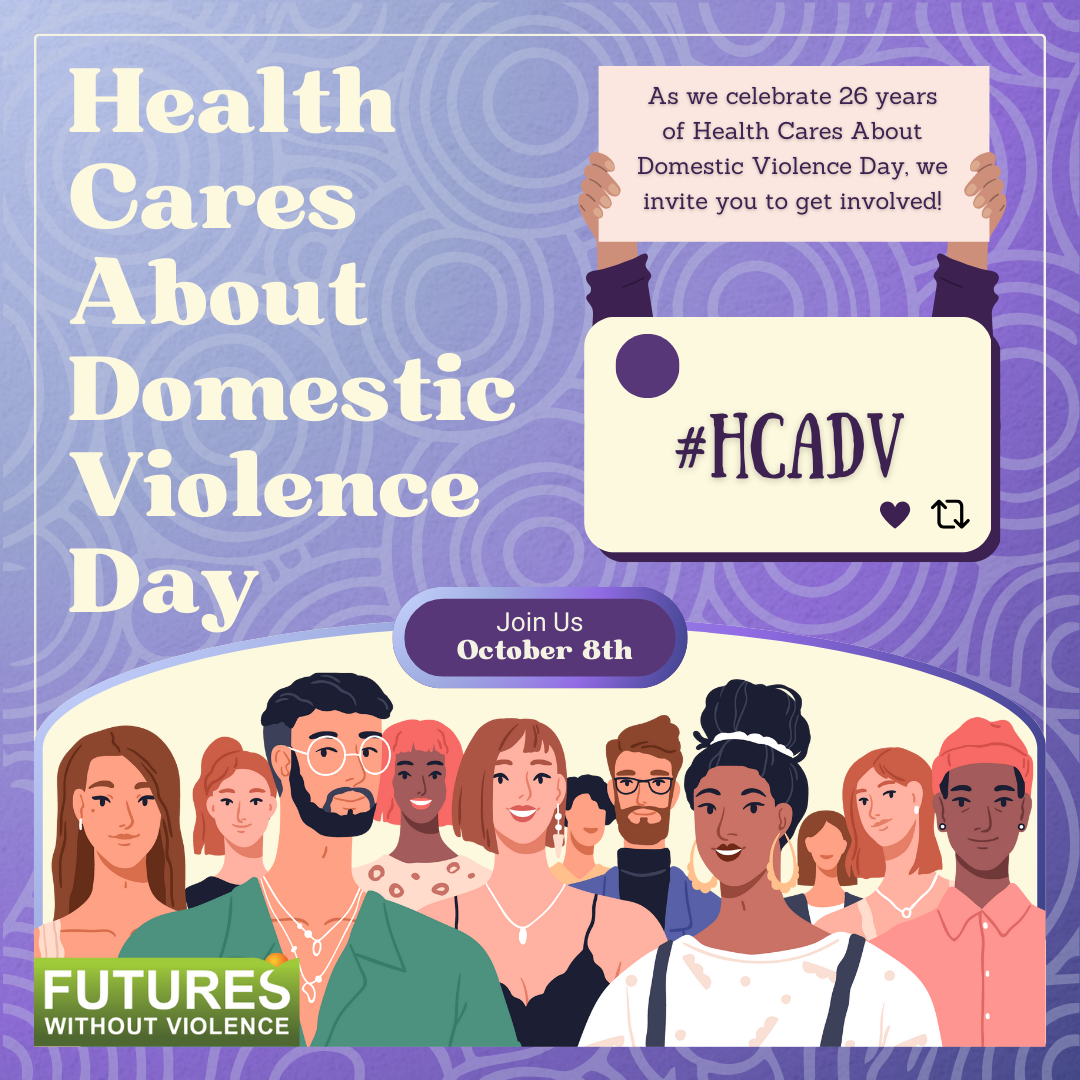
A diverse group of people stands together. Text reads: “Health Cares About Domestic Violence Day. Join us October 8th. #HCADV.” A note invites people to get involved. Logo: “Futures Without Violence.”.

Health Cares About Domestic Violence Day – October 8th, 2025

Health Cares About Domestic Violence (HCADV) Day is an annual, nationally recognized awareness and action day that takes place on the second Wednesday of October. This year on October 8, we invite you to join us for a webinar co-hosted by FUTURES’ programs the National Health Resource Center on Domestic Violence and Health Partners on IPV + Exploitation: Integrating Domestic Violence into Emergency Preparedness Planning & Response.

As the frequency of wildfires, hurricanes, floods, heatwaves, droughts, and various other natural disasters continues to rise across the United States and its territories, health centers and domestic violence programs can expect their operations, workforce, and clients to be increasingly impacted.

This webinar will detail how to integrate IPV support into emergency preparedness efforts, including how to develop partnerships between health centers and local DV programs. Guest Speakers will highlight innovations from the field, key resources and approaches that can be implemented for October Domestic Violence Awareness Month and beyond.

Speakers:

  • Debra Ward, YWCA San Gabriel
  • Rebeca Melendez, ELAWC
  • Sarah Hicks-West, Phoenix Collaborative, LLC
  • Virginia Duplessis, MSW, Director, National Health Resource Center on Domestic Violence
  • Kenede Pratt-McCloud, Program Assistant, Health Partners on IPV + Exploitation, Health Partners on IPV + Exploitation

If you have any questions, please email Kenede Pratt-McCloud at kprattmccloud@futureswithoutviolence.org.

This webinar will be presented in English with Spanish and ASL interpretation. Este seminario web se presentará en inglés con interpretación en español y ASL.

REGISTER HERE


026 Survivor Leadership Cohort: Application Open and Info Session

Monday, September 22, 2025

11am PST/ 12pm MST/ 1pm CST/ 2pm EST (60 minutes)

The National Health Resource Center on Domestic Violence is pleased to announce the launch of the Fourth Survivor Leadership Cohort. Each year we bring together a diverse group of survivors who are interested in supporting the work to improve the trauma responsiveness of healthcare systems. This year we are specifically inviting applications from survivors who work in the health care industry. This could include people who provide direct services in the clinical setting or any other allied health and wellness professionals. Cohort members receive a stipend for participation, build an invaluable community and have the opportunity to expand their leadership and support the work of the HRC. If you or someone you know would be a good fit, please apply and share this application!

Application Available Here  Applications Due Oct. 15

Upcoming Webinars

Strengthening Emergency Preparedness by Addressing IPV/HT/E

September 23, 2025
8am HST/ 11am PST/ 12pm MST/ 1pm CST/ 2pm EST (60 minutes)

In advance of our HCADV webinar, the National Health Resource Center on Domestic Violence and Health Partners on IPV + Exploitation are co-hosting a session about the unique health and safety needs of survivors of IPV/HT/E during public health emergencies and natural disasters. The session will cover Center of Medicare and Medicaid Services (CMS) aligned strategies, prevention-focused tools, protocols, and organizational policy recommendations to help health centers and DSV programs respond effectively during crises.

This webinar will be presented in English with Spanish and ASL interpretation. Este seminario web se presentará en inglés con interpretación en español y ASL.

For More Information and to Register- Click Here

Community of Practice

Building Health Center Responses on Intimate Partner Violence (4-virtual sessions)Health Partners on IPV+ Exploitation will host four virtual educational sessions to discuss intimate partner violence (IPV), including: prevalence and definitions; clinical change strategies including the CUES intervention; HRSA’s UDS measures on IPV/exploitation, and referrals and collaboration strategies to develop comprehensive HC responses. Health Outreach Partners and Migrant Clinicians Network will lead one session with a focus on IPV experienced by migratory seasonal agricultural workers (MSAWs) and will describe outreach strategies, essential partnerships and healing-centered strategies to support staff and patient well-being.

Participation in all four sessions is strongly recommended as each session builds upon the other to deepen understanding.

Four live sessions will be held Wednesdays at 7am HST/10am PST/11am MST/12pm CST/1pm EST and hosted via Zoom for 60 minute sessions.

  • Session 1: Welcome and Community of Practice Introduction, IPV/HT/E Definitions, Health Services, and Community Partnerships. October 22, 2025
  • Session 2: Defining the Health Impact of IPV and the CUES Intervention. October 29, 2025
  • Session 3: Healing-Centered Strategies for Health Center Staff and Patients. November 5, 2025
  • Session 4: How to Operationalize Clinical Change on IPV/HT/E and Key Resources. November 12, 2025
These sessions will be presented in English with Spanish and ASL interpretation. Este seminario web se presentará en inglés con interpretación en español y ASL.

More Information, Including Registration

Hispanic Heritage Month Research and Resource Corner

Domains of Access for Interventions Addressing Intimate Partner Violence Among Latina Immigrants: Protocol for a Systematic Review

Latina immigrants in the United States face barriers to accessing information and support for intimate partner violence (IPV) due to language and cultural differences, a lack of legal awareness, social isolation, and financial issues. Despite numerous interventions, research lacks insight into how these programs address access barriers and target IPV-related risk and protective factors.

Read Article Here

Intimate partner violence and delays in obtaining contraception among young people in California and Texas

Experiencing intimate partner violence (IPV) can negatively impact young people’s reproductive autonomy, including making it more challenging to get contraception. This study examined the association between IPV and delays in obtaining contraception in a sample of young women from California and Texas.

Read Article Here

Effectiveness of Trauma-Informed Messaging Among Women Experiencing Intimate Partner Violence with Adverse Childhood Experience-Related Comorbidities

Trauma-informed communication has shown promise in healthcare settings for supporting individuals affected by adverse childhood experiences (ACEs), yet its application in public health messaging remains underexplored. Given the strong link between ACEs and intimate partner violence victimization (IPVV), this study designed and tested a trauma-informed, text-based message aimed at promoting trauma understanding and positive behavioral intentions among women experiencing IPVV with self-reported ACEs.

Read Article Here

Women’s Perceptions of Maternity Care Responses to Domestic and Family Violence and Abuse: A Systematic Review and Meta-Synthesis of Qualitative Studies

Domestic and family violence (DFV) disproportionately affects women in the perinatal period. Routine DFV screening is known to improve DFV identification, however, it is crucial to understand women’s views of routine DFV inquiry and their post-disclosure needs specific to the maternity care setting. The aim of this qualitative meta-synthesis was to explore perinatal women’s perceptions and experiences of routine DFV screening and post-disclosure practices in antenatal care.

Read Article Here

Resources in Spanish
The National Health Resource Center holds many wonderful resources, several of which are available in Spanish including these safety cards. All of the resources are free and have a flat shipping rate of $12.00 per order. Check out our selection at store.futureswithoutviolence.org.
English